
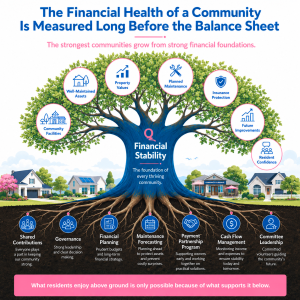
The financial health of a community is measured long before the balance sheet. It isn’t measured when the annual accounts are prepared. It’s measured every time owners contribute towards the place they all share.
Imagine discovering your community’s resident club needs urgent roof repairs… but the money simply isn’t there because a growing number of owners have fallen behind on their fees.
When people hear the word “arrears”, it’s easy to think of it as a private issue between an owners corporation and a lot owner.
Someone hasn’t paid their fees. The manager follows up. Eventually the account is resolved.
Simple.
But in reality, arrears affect far more than just one individual lot account.
Every owners corporation operates on a simple principle:
The community can only deliver services when everyone contributes their share.
Across Victoria, more than one million lots are part of an Owners Corporation community. Together, these communities are responsible for managing hundreds of billions of dollars in shared property assets and the financial health of the community is vital.
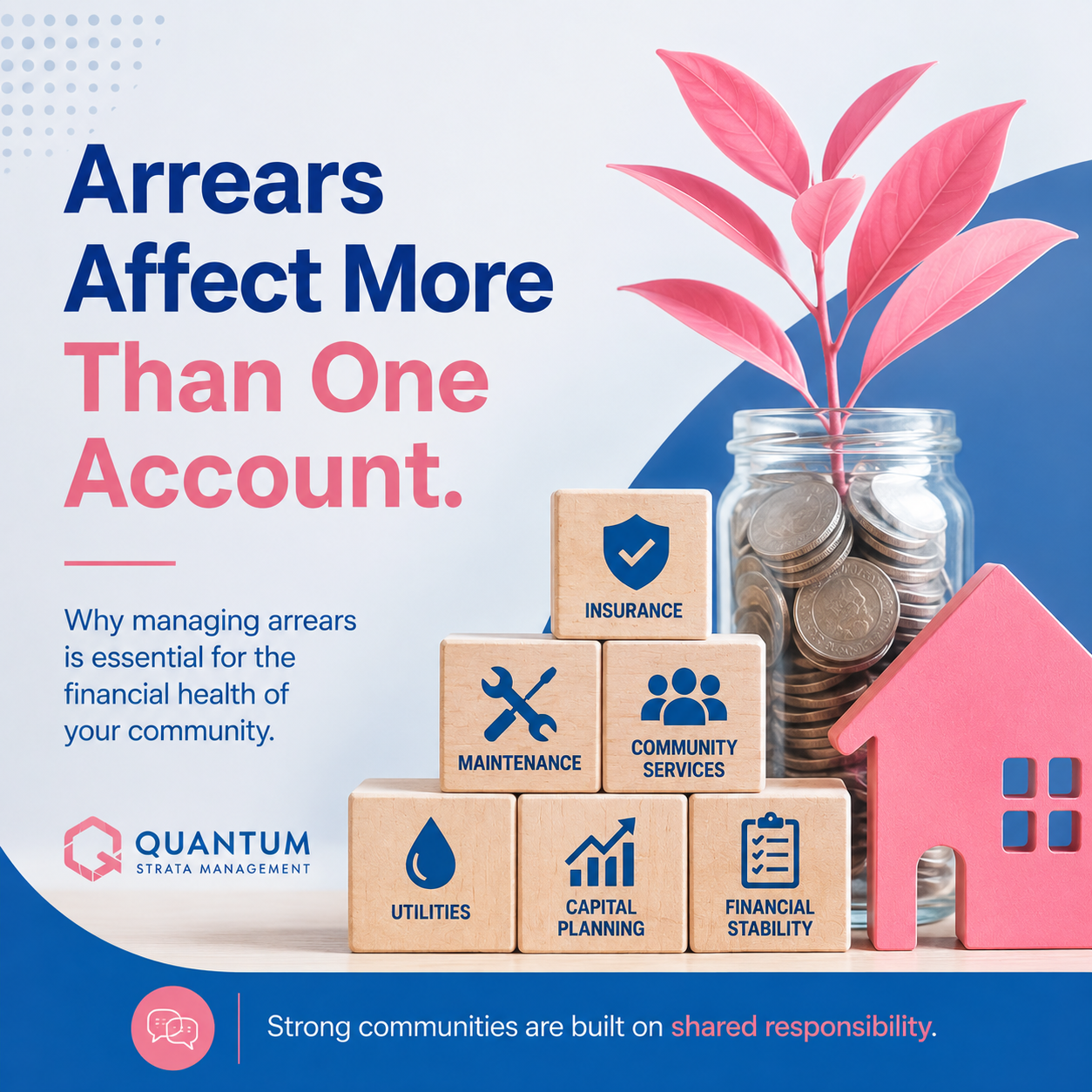
Those quarterly/bi-annual fees aren’t sitting idle in a bank account somewhere. They fund the things residents rely on every day:
- Building maintenance
- Cleaning and landscaping
- Insurance
- Utilities for common property
- Essential repairs
- Capital works planning
- Community facilities and services
When a significant number of lot owners fall behind, the impact begins to ripple across the entire community.
Initially, the owners corporation absorbs the shortfall. But over time, arrears can create pressure in several areas:
Reduced Cash Flow
Communities still need to meet their obligations even when contributions haven’t been received. Insurance premiums still fall due. Contractors still need to be paid. Utilities continue to arrive. Those obligations don’t pause simply because fee contributions haven’t been received.
And when owners’ contributions don’t meet the obligations, it can place strain on day-to-day operations and financial planning.
Deferred Maintenance
When cash flow becomes constrained, committees may be forced to delay non-urgent projects.
But what may start off as small non-urgent maintenance issues can quickly become larger and more expensive problems.
A small roof leak becomes water damage. Cracked asphalt becomes a trip hazard. Delayed painting becomes costly remediation.
Increased Administrative Costs
Debt recovery processes require time, professional involvement, legal oversight, and administrative resources.
These costs ultimately become part of the community’s financial burden.
Pressure on Future Budgets
If arrears become persistent, committees may need to make difficult decisions about future budgets and expenditure priorities.
This is when owners need to understand that arrears simply aren’t just a debt recovery issue.
When unpaid fees begin to accumulate, committees can find themselves facing difficult choices:
- Do we proceed with planned maintenance?
- Can we continue building reserves for future capital works?
- Should projects be deferred?
- How do we balance cash flow without increasing financial pressure elsewhere?
When fee contributions are collected consistently, communities have options. When they are not, choices become more limited.
Across the many communities we manage throughout Victoria, one thing we’ve consistently observed is that
Financially healthy communities don’t “just happen”.
They are built through proactive planning, responsible governance, and a collective commitment from owners to contribute fairly to the communities they call home.
Which is why successful committees monitor arrears in the same way they monitor maintenance plans, budgets, and insurance. Not because they enjoy talking about or policing debt – who does?
But because a committee exercising fiduciary duty needs to be able to answer if their community continue to:
- Maintain its assets?
- Meet its obligations?
- Deliver planned improvements?
- Protect property values?
- Invest in its future?
Supporting Owners Before Problems Escalate
Of course, not every overdue account is the result of unwillingness to pay.
Life happens. Unexpected expenses, changing circumstances, and financial pressures can affect any household at different stages.
That’s why effective financial management isn’t simply about recovering unpaid fees. It’s about creating pathways that help owners remain engaged and connected to their community while meeting their obligations.
At Quantum, we’ve developed a robust and systemised Payment Partnership Program designed to support owners early, encourage open communication, and work towards practical solutions before issues escalate.
Because the best outcomes are rarely achieved through enforcement alone.
They’re achieved through early intervention, clear communication, and a structured process that balances compassion with responsibility.
For communities, this helps protect cash flow and financial stability.
For owners, it provides an opportunity to address challenges before they become significantly more difficult to resolve.
Residents may never see the budgeting discussions, maintenance forecasts, cash flow reports, or arrears recovery processes happening behind the scenes.
But happening in the background of every well-maintained community are thousands of small financial commitments coming together to protect the place they all call home.
And these are often the foundations that allow communities to have the financial resources to deliver on its obligations today while planning confidently for tomorrow.
Here’s some food for thought:
Many owners only see the visible side of community living.
What do you think is the biggest hidden consequence of unpaid fees that residents often overlook?