
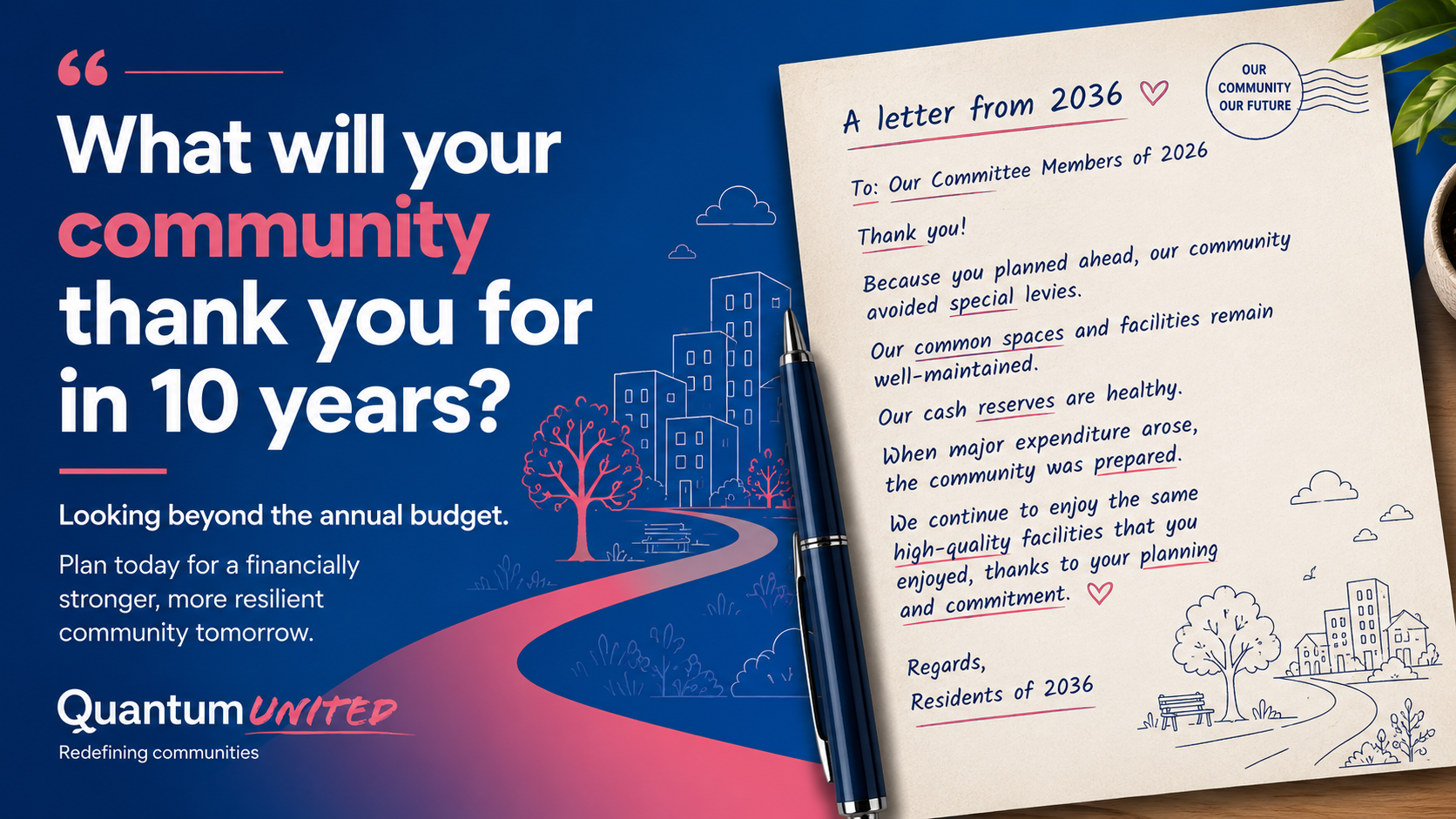
Imagine, for a moment, that the residents of your community ten years from now could write a letter to today’s committee.
What would you hope the letter from 2036 say?
Thank you for planning ahead.
We continue to enjoy the same high-quality facilities that you enjoyed, thanks to your planning and commitment.
Our reserves are healthy, and when major works are required, we are better prepared for them.
When major expenditure arose, the community was prepared.
That’s the idea behind our Letter from 2036.
It’s a simple reminder that financial decisions made around a committee table today can continue to influence a community long after the people making those decisions have moved on.
And it changes the question from:
“What levy do we need this year?”
to:
“What financial position do we want this community to be in ten years from now?”
Looking Beyond the Annual Budget
Every Owners Corporation approves a budget each year.
It’s an important process that helps determine levies, meet operating expenses and keep the community running.
But a balanced annual budget doesn’t necessarily mean a financially healthy community.
Because while a budget tells us what a community needs today, good financial planning asks a much bigger question:
What will this community need tomorrow — and are we preparing for it now?
A Balanced Budget Can Still Hide Future Costs
It’s easy to look at a budget that covers the year’s expected expenses and conclude that the community is in a strong financial position.
But some of the biggest costs an Owners Corporation will face don’t arrive neatly within a 12-month budget cycle.
That’s why focusing only on the annual budget can create a false sense of affordability.
A community may appear financially comfortable today while future obligations quietly accumulate in the background.
The result isn’t always financial hardship. Sometimes, it’s simply financial surprise. And surprise can be far more difficult to manage than preparation.
Communities that take a long-term approach are often better positioned to manage asset renewals, minimise financial surprises, and make informed decisions about their shared property.
That’s why maintenance planning becomes so valuable.
Every asset has a lifecycle and wears out eventually. Roads, gates, lighting, landscaping infrastructure, recreational facilities and other shared assets will, at some point, require significant maintenance, renewal or replacement.
The question is not whether community assets will eventually require investment. It is whether the community will be financially prepared when they do.
Long-Term Planning Creates Stability
At Quantum, we encourage committees to treat annual budgeting and maintenance planning as two parts of the same financial conversation.
One part manages today’s operations. The other helps prepare for tomorrow’s obligations.
A well-prepared and regularly reviewed Maintenance Plan is one of the most valuable tools available to an Owners Corporation.
It doesn’t simply provide a list of things that may need replacing one day. It provides a financial roadmap.
A quality maintenance plan helps communities:
- Understand future capital expenditure requirements
- Anticipate major asset renewal and replacement costs
- Spread financial contributions more fairly over time so the cost of renewing shared assets is not borne solely by the owners who happen to be there when replacement becomes necessary
- Reduce the likelihood of unexpected special levies
- Make decisions based on realistic forecasts rather than urgency
Planning gives committees more time, more options and more room to make considered decisions. Urgency tends to do the opposite.
There is another important principle behind long-term financial planning: the people enjoying a community’s assets today are also contributing to their eventual renewal.
Setting aside funds progressively means the eventual cost is not necessarily left entirely to the owners who happen to be there when major maintenance or replacement becomes necessary.
Instead, contributions can be made over time by the generations of owners who benefit from those assets along the way. It is a simple principle of fairness: if we benefit from an asset while it is being used, we also contribute towards the day it will need to be renewed.
Good Financial Stewardship Has a Longer Horizon
Long-term planning does not mean predicting every expense perfectly. No maintenance plan can foresee everything: unexpected expenditure will happen, priorities will change, costs will move and communities will evolve. Good financial stewardship is about being prepared enough to respond when those changes occur.
It means periodically looking beyond the next AGM and asking whether today’s contributions, reserves and financial decisions reflect what we reasonably know about tomorrow.
And sometimes it means having difficult conversations today so that a future committee isn’t left with an even more difficult one.
Five questions worth asking at your next budget discussion
When your committee next considers its budget and financial position, try looking beyond the next 12 months.
Ask:
- What are our largest anticipated expenses over the next five to ten years?
- Are the cost assumptions in our Maintenance Plan still realistic?
- Are current contributions keeping pace with our projected future obligations?
- What expenditure have we deferred, and what could delaying it ultimately mean for the community?
- If a significant unexpected expense arose tomorrow, how financially resilient would our Owners Corporation be?
They aren’t always easy questions but they are valuable ones because successful communities aren’t built one budget cycle at a time.
They’re built through consistent planning, informed decision-making and a willingness to look beyond what a community needs today to consider what it will need tomorrow.
Owners today contribute fairly towards the community they enjoy, while helping prepare it for those who come after them.
The real measure of good financial planning is not simply whether this year’s budget balanced. It is whether the community continues to enjoy the same quality of assets and facilities ten years from now – without one generation being left to carry the cost alone.
#OwnersCorporation #StrataManagement #CommunityLeadership #FinancialPlanning #QuantumUnitedManagement