
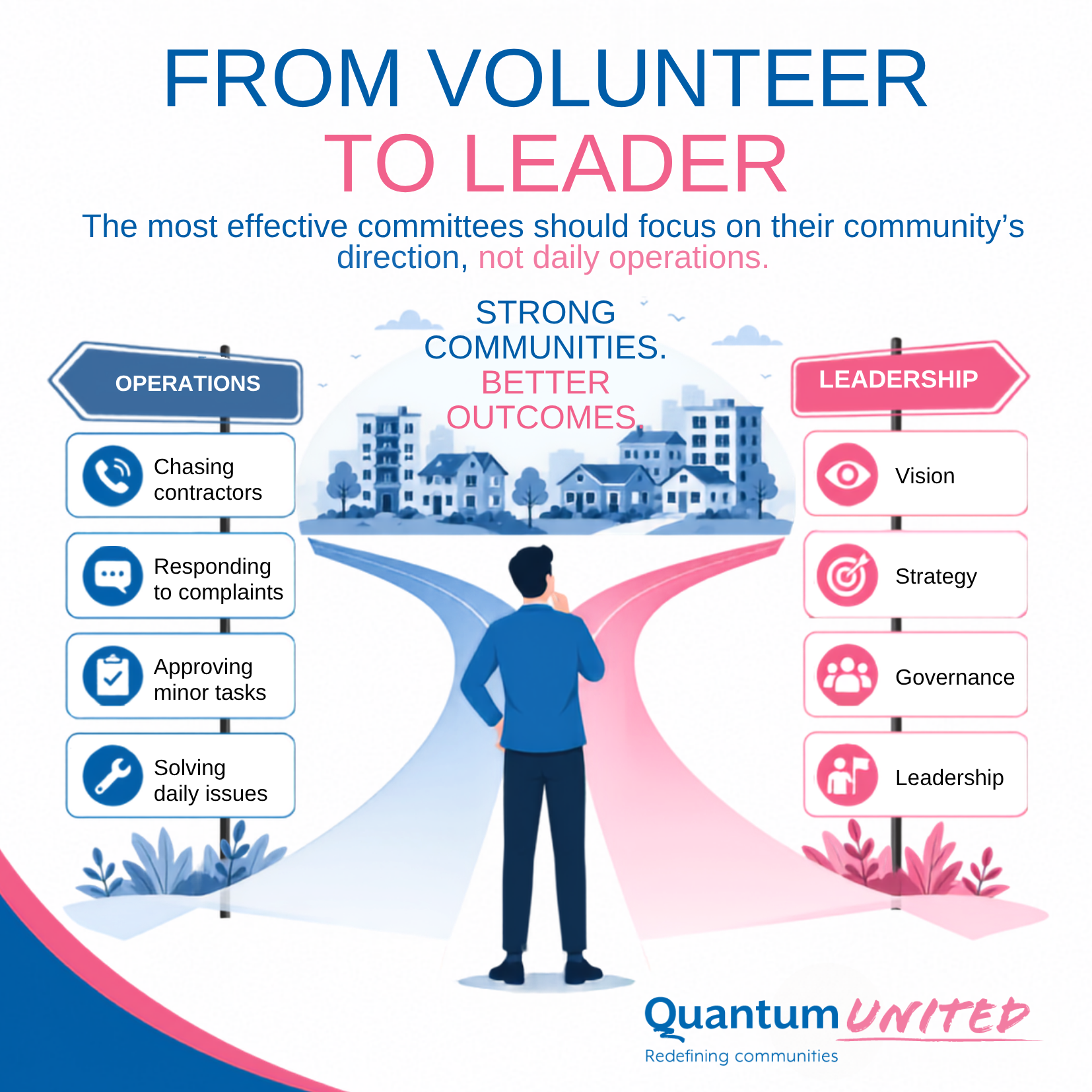
Most committee members don’t put their hand up because they relish in the dream of reviewing invoices or the nightmares of following up contractors, managing debt recovery processes, and coordinating maintenance schedules.
They volunteer because they care about where they live.
They want to see their neighbourhood thrive, protect property values, contribute to important decisions, and help shape the future of the place they call home.
Yet somewhere along the way, many well-intentioned committees unknowingly stop leading the community and gradually find themselves becoming operational managers.
THE MINDSET SHIFT: FROM DOING TO GOVERNING
The Owners Corporations Act 2006 (VIC) establishes committees to make decisions on behalf of the Owners Corporation, while professional managers assist by implementing those decisions.
A useful way to think about it is this:
The committee’s role is to set the direction
Asking good questions, exercising sound judgement, establishing priorities, making informed decisions in the best interests of all owners
Management helps navigate the journey
By providing professional guidance, reliable information and the systems that support confident decision-making.
Once decisions are made, management brings the resolutions to life by coordinating services, meeting legislative obligations and keeping the Owners Corporation running smoothly.
When these roles complement each other, communities benefit from clearer decision-making, stronger governance, and better outcomes.
When the lines become blurred, frustration often follows.
THE TRAP MANY COMMITTEES FALL INTO
It usually starts with good intentions.
A resident raises a concern, so a committee member gets involved with the issue directly.
An overdue lot account appears on the arrears report, so someone wants to micromanage the recovery process.
Before long, committee meetings become focused on operational details rather than strategic decisions when their role is to determine whether the right systems, processes, and priorities are in place to ensure those activities are being handled effectively.
THE THREE LEVELS OF COMMITTEE THINKING
Every Committee discussion tends to fall into one of three levels.
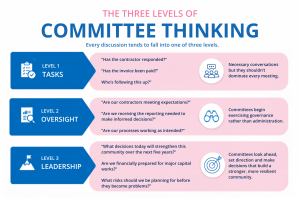
The strongest committees don’t eliminate operational discussions. They simply ensure those discussions focus support the bigger picture.
CREATING SPACE FOR LEADERSHIP
One of the greatest values a professional manager can provide isn’t completing more tasks.
It’s removing day-to-day operational noise.
Every committee meeting has a limited amount of time and attention. The more that time is consumed by chasing contractors, interpreting financial reports or searching for background information, the less capacity remains for governance.
That’s why effective management is about far more than reactively coordinating maintenance and administration.
It’s about having systems that surface the right information, present clear options, and give committees the confidence to focus on the decisions only they can make.
When committee members receive structured reports, meaningful financial insights, clear recommendations and transparent communication, the conversation naturally shifts and creates the conditions that allow committees to remain focused on leadership.
A good manager doesn’t just manage the community. They create space for committee members to lead it.
Does your current management approach support that?