
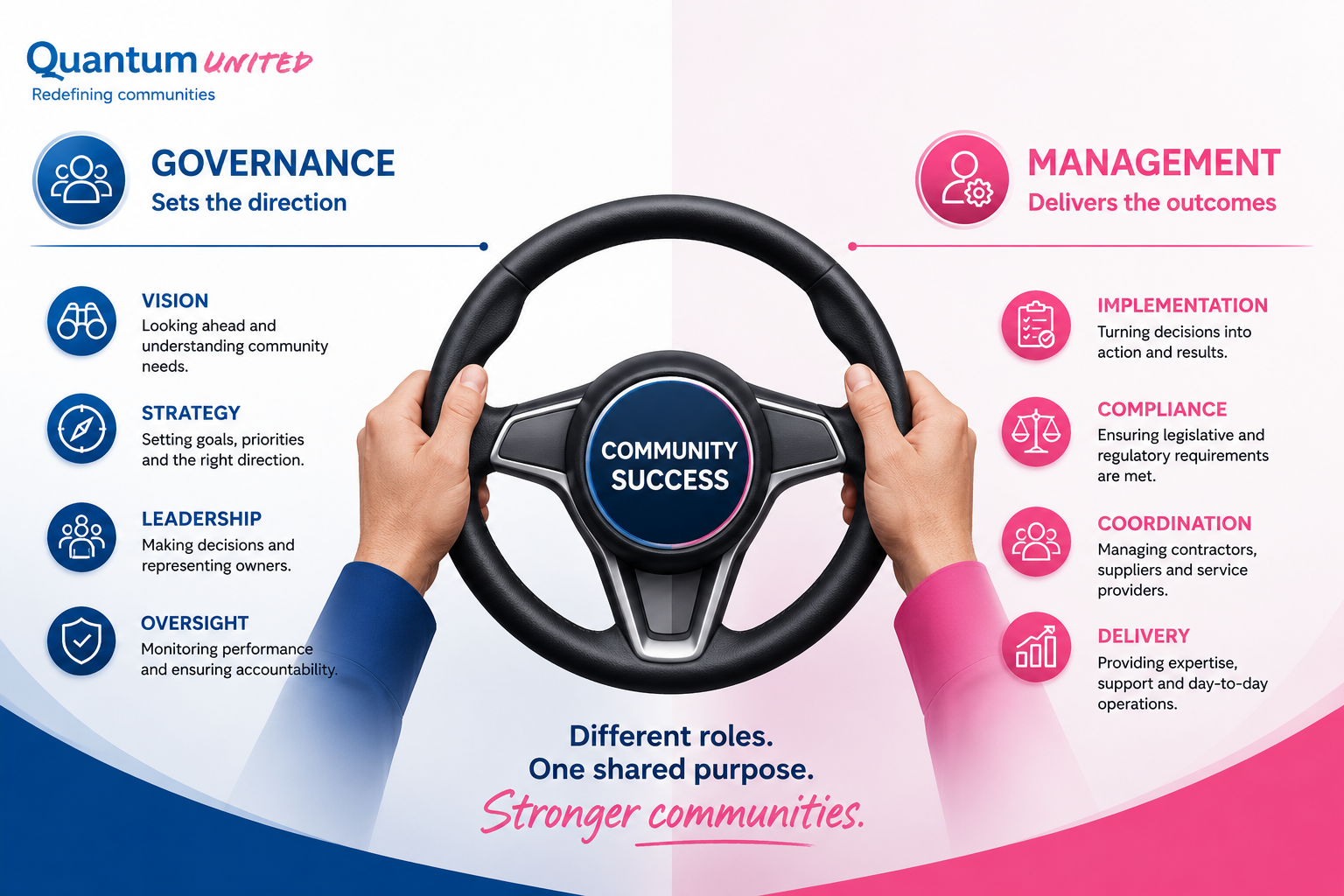
One of the most common misunderstandings in community living is the difference between governance and management.
The two terms are often confused and used interchangeably, yet they serve very different purposes.
Governance is about direction.
Management is about execution.
A committee’s role is to represent the interests of the Owners Corporation, make decisions on behalf of lot owners, establish priorities, and provide strategic oversight. They determine what needs to be achieved and why.
The manager’s role is to implement those decisions, provide professional guidance, ensure compliance with legislation, coordinate contractors and service providers, and help keep the community operating smoothly. They determine how those decisions are carried out.
When governance and management are clearly understood, communities tend to be more collaborative, productive and effective.
Problems often arise when the lines become blurred.
Committees can become frustrated when they feel they are handling operational tasks that should sit with management. Managers can become constrained when they are expected to make decisions that rightly belong to elected committees.
Strong communities recognise that governance and management are not competing functions. They are complementary ones.
Good governance provides vision, accountability and leadership.
Good management provides expertise, structure and delivery.
Neither works particularly well without the other.
As communities become larger and more complex, the importance of this partnership only grows. Long-term planning, financial sustainability, community engagement, maintenance programs and risk management all rely on committees and managers understanding their respective responsibilities.
The most successful communities are not those with the most active committees or the most experienced managers.
They are the communities where governance and management work together with mutual respect, clear expectations and a shared commitment to the long-term success of the community.
The question every committee should regularly ask is not “Who is responsible for this?”
It is:
“Are we operating in the role we were elected or appointed to perform?”
Because when governance leads and management delivers, communities thrive.